
Prepared by:
2022
Commissioned by the Hungarian Hydrogen Technology Association, by the
INSTITUTE FOR TRANSPORT SCIENCES (KTI)

A very important question for the MHT Association's Green Truck Project is where the hydrogen refuelling stations serving heavy goods vehicles should be located. KTI's study seeks to determine this; it focuses primarily on the busier TEN-T routes and bases its modelling on different penetration rates (scenarios) of hydrogen-powered trucks on these routes. It also takes into account the major industrial and logistics centres (especially intermodal hubs) within a defined proximity, the major cities (urban nodes) and their population, which may be the main “attractors” for hydrogen-powered trucks. It further took into account the locations of known projects (hydrogen bus, refuse truck, etc. projects known so far) that are likely to implement hydrogen mobility projects in the near future, as well as the refuelling stations already existing in neighbouring countries, with which it is advisable to align to some extent to ensure the international interoperability of hydrogen corridors.
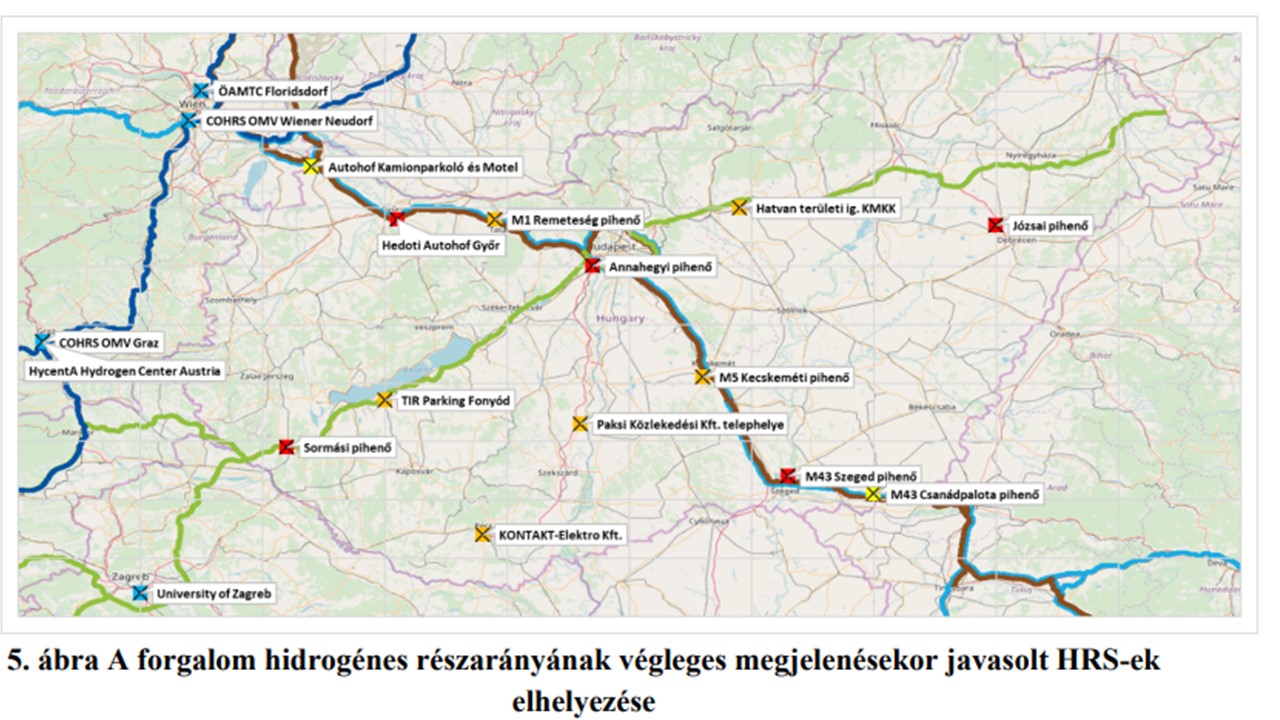
Particular emphasis was placed in the modelling on motorway service areas (with existing filling stations) along the TEN-T network or within ~1 km of it, and on the distances between them, as hydrogen refuelling stations are very likely to be installed integrated with these. Data analysis was carried out in MS Excel, and the GIS operations and data visualisations using QGIS software. (The analysis focuses only on heavy goods vehicles and does not account for FCEV passenger cars.) Following data collection, a detailed GIS analysis was performed on the data imported into QGIS.
The GIS processing was carried out in the EOV projection system, so the final result is also available in map form. The study ranked the locations obtained from the modelling into high, medium and low priority. The service areas with the highest scores are the most important in terms of priority, but under this deployment scenario refuelling stations would still appear only sporadically.
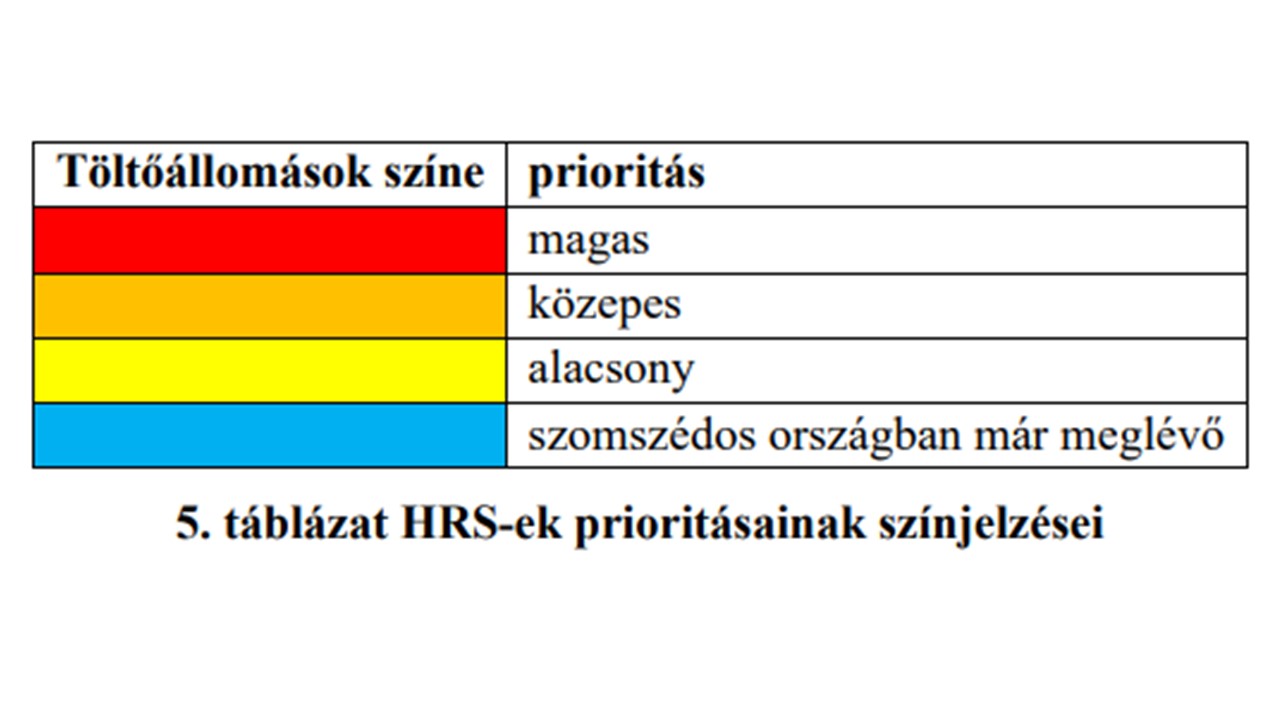
Service areas marked in orange are considered of medium priority and correspond to a realistic deployment scenario. Service areas of lower priority are shown in lemon yellow; due to the higher number of service areas, this deployment scenario already shows widespread coverage.