
Prepared by:
Commissioned by the Hungarian Hydrogen Technology Association
Budapest University of Technology and Economics, Faculty of Transportation Engineering and Vehicle Engineering, Department of Transport Technology and Economics
Structure of the study:
- Introduction.
- International outlook.
- Battery rail traction.
- Komárom–Esztergom–Székesfehérvár battery traction.
- Hydrogen traction.
- Hydrogen rail traction on the Hatvan–Lučenec line.
Alternatively powered vehicles make a major contribution to achieving climate neutrality and reducing the pollutants emitted by (rail) transport. However, the technology of these vehicles is new or relatively new in Europe, so a number of conditions must be met in terms of vehicles, servicing facilities and human resources to ensure safe and reliable operation.
Vehicle procurement requirements:
-
- Procurement of a sufficient number of – line-specific – battery or hydrogen multiple units, or possibly conversion of diesel vehicles;
- For the lines examined, a total of 12 hydrogen-powered and 4 electric multiple units need to be purchased.
- When procuring the vehicles, the provision of reserve vehicles should also be considered.
Requirements related to servicing facilities:
-
- Creation of charging/refuelling infrastructure for both hydrogen-powered and battery-powered vehicles:
- Hydrogen operation: depending on the nature of the refuelling station (public or private use) and the amount of fuel to be dispensed at one time, installation of a compressor of adequate capacity and storage bundles of adequate capacity. Based on CNG operation, a compressor with a capacity above 2,000 m3/h is recommended, with storage of about 1 tonne of hydrogen compressed to 200 bar;
- For battery operation, adequate grid capacity is crucial. In other words, it must be ensured that the central charging unit can draw a current of 800 A from the grid and continuously provide a rated output of 600 W;
- Safety preparation of maintenance units and facilities for the safe handling of high-pressure gas and high voltage. There are currently no legal requirements or disaster management recommendations for these conversions. Examining and developing this at national level is crucial;
Human resource requirements:
-
- Continuous training of drivers – with the involvement of the manufacturer – for efficient and energy-saving driving of vehicles with a changed powertrain;
- Continuous, regular and comprehensive training of maintenance staff – with the involvement of the manufacturer – for efficient, economical and, above all, safe operation and maintenance.
Numerous publications [12,13,14] deal with hydrogen and battery propulsion. One study discusses the tasks of the various stakeholders, identifying the tasks of the state, operators, energy suppliers, developers and authorities:
-
- State tasks: consider integrating FCH trains into the public transport strategy and support the development and deployment of FCH trains;
- Operator tasks: examine the deployment options for FCH trains (e.g. most suitable lines, multimodal refuelling terminals) and consider retrofitting existing stations with FCH technology (long vehicle life);
- Energy supplier tasks: examine large-scale hydrogen refuelling stations from the perspective of hydrogen supply, and consider examining the transport of hydrogen supplies by other modes of transport;
- Developer tasks: examine how FCH technology can be adapted to local needs;
- Government tasks: enable the spread of the technology by including it in the transport strategy.
A study by Ballard Power [15] examining the uptake of FCH solutions in Europe concluded that they are expected to account for a 20% share of the new rolling stock market by 2030. Three market segments were analysed:
-
- The largest share, 30%, is expected for multiple units (relative to the current market for diesel vehicles), as ready-made solutions already exist here. Operating costs are forecast to be similar to those of diesel multiple units, which, on low-traffic lines, is a significantly more favourable way to reduce emissions than electrification.
- For shunting locomotives, the study currently identifies low market demand, the main reason being the lack of available vehicles. (As established in Chapter 2, this segment is indeed dominated by home-built prototypes produced by railway operators' own workshops, and the major manufacturers do not yet have ready products.)
- A similar conclusion is reached for main-line locomotives: vehicles are not yet available, so the spread of FCH locomotives is still some way off.
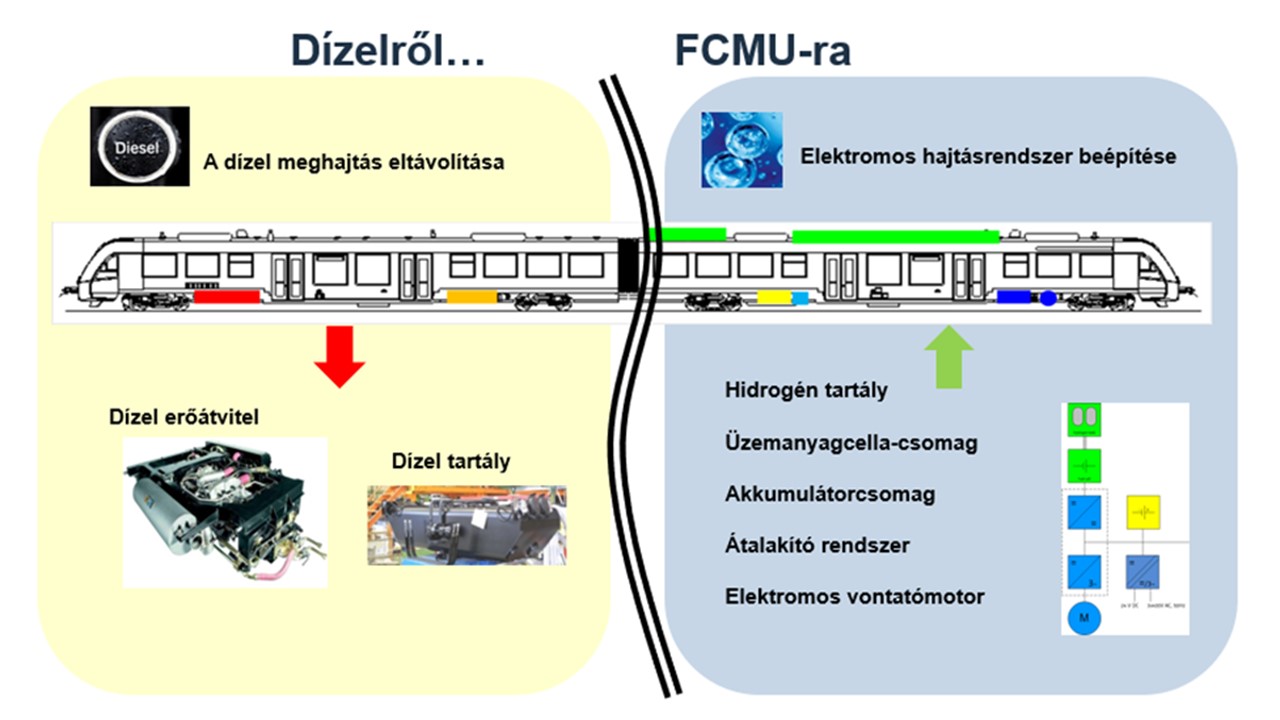
In addition, the study identifies five main advantages of hydrogen fuel cell propulsion:
-
- Flexible hybridisation options (can be combined with batteries)
- Fast refuelling
- Avoiding the constraints of purely battery propulsion (e.g. range, charging time)
- Lower total cost of ownership (compared with diesel propulsion, and in some cases even compared with overhead-line operation)
- Uncompromising performance
In addition to this study and the locations, under the retrofit programme of the Budapest University of Technology and Economics and its partners, Bzmot railcars would be converted to hydrogen propulsion on an experimental basis, provided the necessary resources are available.